
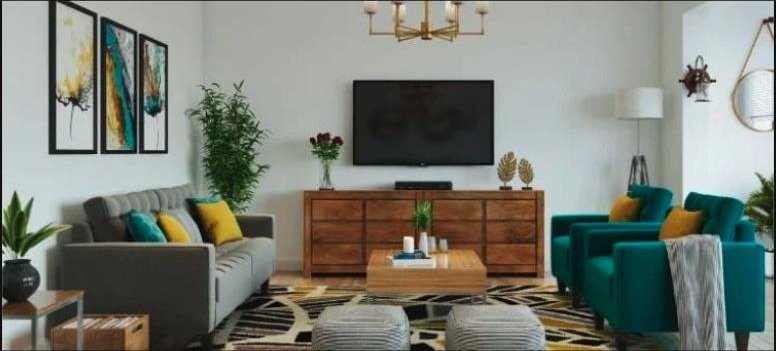
In a small living room, every piece of furniture has to justify its footprint — there's no room for anything that's purely decorative and doesn't pull its weight functionally. Here's what actually works, based on the compact living rooms we design most often.
Choose Multi-Function Furniture
- A storage ottoman doubles as a coffee table, extra seating and hidden storage in one piece.
- A sofa-cum-bed is a smart choice if the living room occasionally doubles as a guest room.
- Nesting tables give you the flexibility of extra surfaces that tuck away completely when not needed.
Scale Seating to the Room
A 3-seater plus loveseat combination often works better in a small room than a large L-shaped sectional, which can dominate the entire floor plan. Choose sofas with visible, slim legs rather than a boxy base touching the floor — it creates a sense of light, open space underneath that a heavier base doesn't.
Use Vertical Space for Storage
A wall-mounted TV unit or floating shelving frees up floor space entirely compared to a floor-standing entertainment unit, and tall, narrow storage (rather than wide, low units) makes better use of a small room's limited floor footprint while still holding as much.
Keep a Consistent, Light Colour Palette
A cohesive, lighter colour scheme across furniture and walls makes a small room read as more open than a busy mix of bold, contrasting pieces. Save bolder colours for a single accent piece — a cushion set, an accent chair — rather than spreading them across every item in the room.
Ask about built-in, wall-hugging storage designs during your consultation — they typically free up 15–20% more usable floor space than freestanding furniture of the same capacity.
Don't Over-Furnish
The instinct in a small room is often to add more furniture to "use" every corner — but a slightly sparser room with well-chosen, well-proportioned pieces almost always feels more comfortable to actually live in than one that's fully packed.
Frequently Asked Questions
What furniture works best in a small living room?
Multi-function pieces — storage ottomans, nesting tables, sofa-cum-beds — and furniture with slim, visible legs that keep the room feeling open.
Should I choose a sectional sofa for a small living room?
Generally, a 3-seater plus loveseat combination is more flexible and less dominating in a small room than a large L-shaped sectional.
Do light colours really make a small living room feel bigger?
Yes — a cohesive, lighter palette reflects more light and reads as more open than a busy mix of bold, contrasting furniture colours.